Japan SIM Card vs Pocket WiFi vs eSIM for Tourists (2026)
Japan SIM card, pocket WiFi or travel eSIM? Compare options, airport pickup, free WiFi and the best choice for solo travelers and groups in 2026.

Mariami Burjanadze
Aviaesim Project Manager & Writer
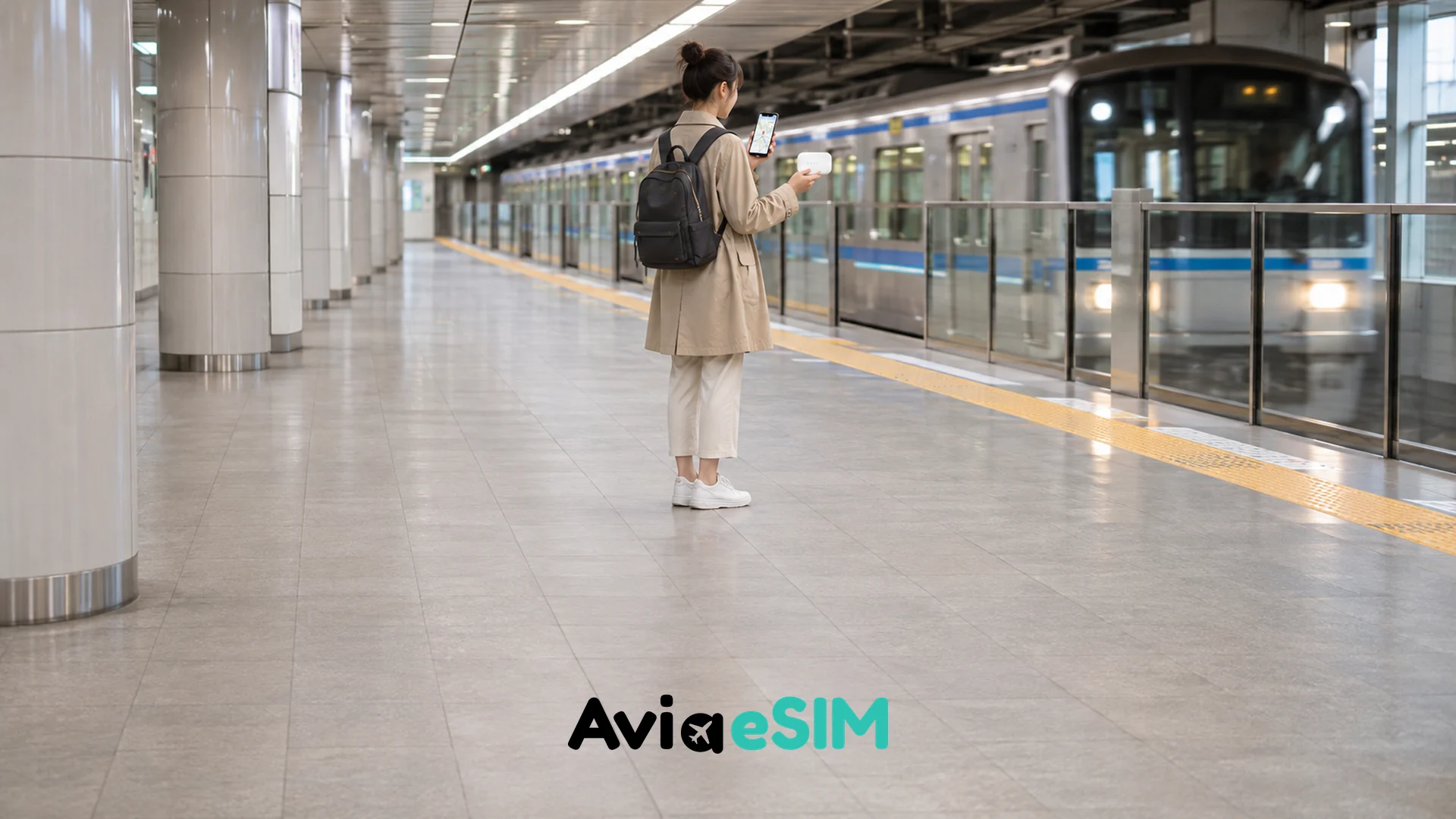
Key takeaways
- Japan has four mobile networks: NTT docomo, au (KDDI), SoftBank and Rakuten Mobile, with excellent coverage in cities and along rail lines.
- Prepaid SIMs sold to tourists are almost always data-only, because a Japanese number with calls generally requires a residence card.
- Data SIMs are sold in the arrival lobbies at Narita Terminals 1 and 2, Haneda Terminal 3 and Kansai Terminal 1.
- Pocket WiFi suits groups that stay together, while a travel eSIM installed before the flight is the simplest choice for solo travelers and couples.
- Free WiFi at airports, stations and convenience stores is a useful backup, but it is patchy on trains and between hotspots.
Picking the right Japan SIM card, pocket WiFi or Japan eSIM comes down to one question: who needs data, and how many devices? Solo travelers with a modern phone are usually happiest with an eSIM, groups sharing one connection often prefer pocket WiFi, and physical SIMs suit older unlocked phones.
Picture the moment after immigration at Narita or Haneda. You need a train route into the city, your hotel's check-in instructions are buried in an email, and somebody back home wants to know you landed. Japan is one of the most connected countries on earth, yet visitors still lose their first hour hunting for a SIM counter, queueing for a rental router or wrestling with a hotspot login page.
This guide compares all three options honestly, with practical tips for airports, trains and day trips, so you can decide before you board your flight.
How mobile internet works in Japan for visitors
Japan has four mobile network operators: NTT docomo, au (run by KDDI), SoftBank and Rakuten Mobile, the newest of the four. Coverage from the big three is excellent in cities, along rail lines and in most tourist regions, including temples in the hills around Kyoto and ski towns in Hokkaido.
Visitors rarely sign a contract with these carriers directly. Instead, you get access to their networks in one of three ways: a prepaid tourist SIM, a rented pocket WiFi router, or a travel eSIM that you install on your own phone before departure. International roaming from your home carrier is a fourth route, but it is often the most expensive one.
One detail surprises many travelers: prepaid SIMs sold to tourists are almost always data-only. A Japanese phone number with regular calls generally requires a residence card, which short-term visitors do not have. In practice that rarely matters, because messaging and calling apps work over mobile data.
Japan SIM card for tourists: where to buy and what you get
A physical Japan SIM card is still easy to find. Arrival lobbies at Narita (Terminals 1 and 2), Haneda (Terminal 3) and Kansai (Terminal 1) have counters for prepaid data SIMs, and Kansai Airport also has a SIM vending machine. Electronics stores in Tokyo and Osaka sell them too.
Typical plans are sold either by duration, such as 7, 15 or 30 days, or by data volume, such as 2 GB to 6 GB valid for a month. Before buying, check two things:
- Your phone is unlocked. A carrier-locked handset will reject a foreign SIM.
- Your phone supports Japanese network bands. Most recent iPhone, Samsung and Pixel models do, but older or regional models may not.
The downsides are practical: you lose access to your home SIM while the tourist SIM is in the tray (unless your phone has dual SIM), the tiny ejector pin is easy to misplace, and airport counters can have queues after several long-haul flights land at once.
Pocket WiFi in Japan: when a router makes sense
Pocket WiFi is a small battery-powered router that creates a private hotspot for several devices. It became popular in Japan years before eSIM existed, and rental desks are still a familiar sight at major airports.
You reserve online, collect the router at the airport or have it delivered to your hotel, and return it at the end of the trip. Many rental companies include a prepaid envelope so you can drop the router into a post box before your flight home. Airline partner rentals list daily fees of around 1,000 to 1,500 yen, and cancellation fees can apply if you change plans close to the pick-up date.
Pros and cons of pocket WiFi
- Good for groups: one router can connect a family or a group of friends, as long as everyone stays together.
- Works with any device: tablets, laptops and locked phones connect over WiFi.
- Another gadget to manage: the router needs charging every night, and a long day of maps and photos can drain it before dinner.
- Shared connection: if one person heads to a museum and another goes shopping, only one of them has internet.
- Return logistics: a lost or late router can lead to extra charges.
Pocket WiFi or personal data? Traveling as a group in Japan
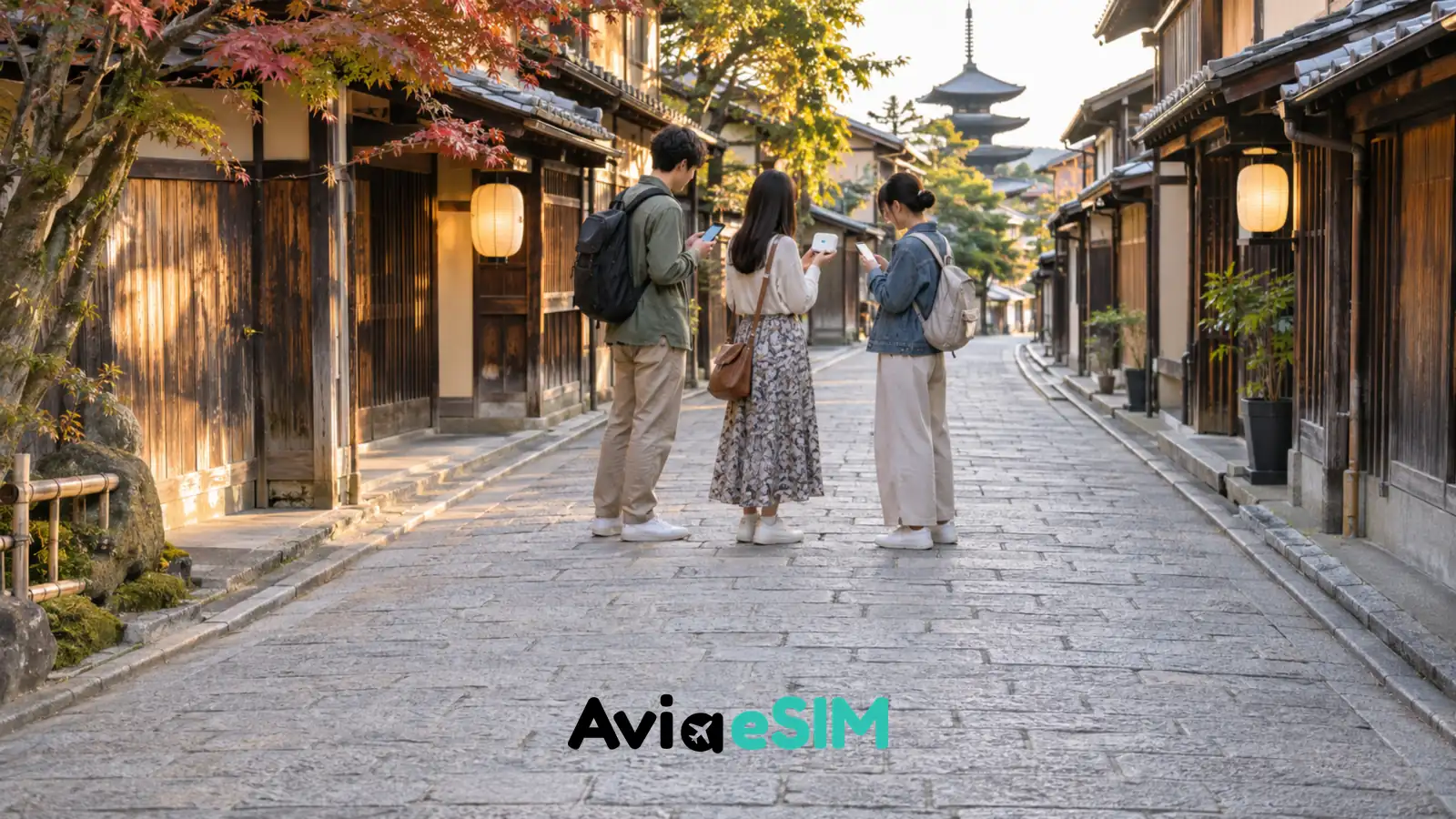
Group travel is where the choice really matters. A couple who spend every minute together can share one router comfortably. A group of four friends who split up in Kyoto, with two visiting Fushimi Inari and two heading to Nishiki Market, will quickly discover that only one half of the group can check the bus times.
A practical rule: if your group will split up even once a day, give each person their own data. Separate eSIMs avoid arguments about who carries the router, and nobody is left offline when the battery dies. Families with young children who stay together all day are the strongest case for a single pocket WiFi.
Travel eSIM for Japan: the simplest option for most visitors
An eSIM is a digital SIM profile that you download to your phone, usually by scanning a QR code. You can buy and install it at home, then switch it on when your flight lands, so you already have data while the plane taxis to the gate.
For most solo travelers and couples with recent phones, this is the most convenient setup:
- No queues and no pick-up: nothing to collect at the airport and nothing to return.
- Keep your home number active: your regular SIM stays in the phone for bank SMS codes, while the eSIM handles data.
- One device, one battery: no extra router to charge.
- Easy to extend: if you stay longer, you can usually add data from your phone.
Two limits are worth knowing. Your phone must support eSIM and be carrier-unlocked, and most travel eSIMs are data-only, just like tourist SIMs. If you plan to explore beyond the capital, a Tokyo eSIM or an eSIM for Osaka and Kansai covers the same national networks, so day trips to Nara, Kyoto or Hiroshima stay connected.
Japan SIM card vs pocket WiFi vs eSIM vs roaming: quick comparison
- Local tourist SIM: good value for long stays, needs an unlocked phone with a physical SIM slot, data-only in most cases, and you may queue at the airport.
- Pocket WiFi: best for groups that stay together and for devices without cellular data, but adds a gadget to charge, carry and return.
- Travel eSIM: fastest setup, installed before departure, keeps your home number, ideal for solo travelers and couples with compatible phones.
- Home carrier roaming: zero setup, but daily passes can cost far more over a two-week trip, so check your carrier's rates first.
Free WiFi in Japan: useful backup, not a plan
Free WiFi in Japan has improved a lot. Narita offers "Free WiFi-NARITA" and Haneda offers "HANEDA-FREE-WIFI", both without registration. JR East stations have "JR-EAST_FREE_Wi-Fi", the Tokyo Metropolitan Government runs "TOKYO_FREE_Wi-Fi", and chains such as Starbucks and Lawson have their own networks.
Tokyo Metro runs "Metro_Free_Wi-Fi" at many of its stations, with sessions of up to three hours after an email sign-up. Its official page recently noted that the service was suspended for equipment upgrades, so check the current status rather than counting on it.
The "Japan Wi-Fi auto-connect" app can save you from repeating login pages at participating hotspots. Still, free networks drop out between stations, inside trains and on mountain trails, which is exactly when you need maps the most.
Practical tips before you fly to Japan
- Install your eSIM at home on a stable WiFi connection, and keep the QR code in an email in case you need to reinstall.
- Turn on data roaming for the eSIM line only and set it as your data line, while keeping your home SIM's data switched off.
- Download offline maps of Tokyo, Osaka and Kyoto as a safety net.
- Save hotel addresses in Japanese to show taxi drivers.
- Pack a power bank. Navigation, translation apps and photos use more battery than you expect.
Japan SIM card FAQ
Can tourists get a Japanese SIM card with a phone number?
Usually not. SIMs sold to short-term visitors are typically data-only, and a voice plan with a Japanese number generally requires a residence card. Use messaging and calling apps over mobile data instead.
Is pocket WiFi or an eSIM better for Japan?
For solo travelers and couples with eSIM-compatible phones, an eSIM is simpler: no pick-up, no return and no extra battery. Pocket WiFi suits groups that stay together all day or travelers with devices that cannot use an eSIM.
Where can I buy a SIM card at Japanese airports?
Prepaid data SIMs are sold in the arrival lobbies at Narita Terminals 1 and 2, Haneda Terminal 3 and Kansai Terminal 1, and Kansai Airport also has a SIM vending machine. Opening hours and stock can change, so an eSIM installed in advance is the most predictable option.
Does free WiFi in Japan work well enough without mobile data?
Free WiFi is common at airports, many stations, convenience stores and cafes, but it is patchy on trains and between hotspots, and some networks require registration. It works as a backup, not as your main connection.
Will my eSIM work on day trips outside Tokyo?
Yes. Travel eSIMs for Japan connect to national networks, so coverage continues on the Shinkansen routes and in places like Kyoto, Nara and Hakone. Very remote mountain areas can still have weak signal.
One last tip for multi-country trips
Many travelers combine Japan with a second stop in Asia. If your plane tickets continue to Seoul, Taipei or Hong Kong, sort out data for each leg before you leave home. A South Korea eSIM or an eSIM for Seoul, a Taiwan eSIM or a Hong Kong eSIM can be installed alongside your Japan profile, and heading on to the mainland is easier with a China eSIM.
Japan eSIM from $1.30: compare plans and install yours before you fly at AviaeSIM Japan eSIM plans.
Frequently asked questions
Can tourists get a Japanese SIM card with a phone number?
Usually not. SIMs sold to short-term visitors are typically data-only, and a voice plan with a Japanese number generally requires a residence card. Use messaging and calling apps over mobile data instead.
Is pocket WiFi or an eSIM better for Japan?
For solo travelers and couples with eSIM-compatible phones, an eSIM is simpler: no pick-up, no return and no extra battery. Pocket WiFi suits groups that stay together all day or travelers with devices that cannot use an eSIM.
Where can I buy a SIM card at Japanese airports?
Prepaid data SIMs are sold in the arrival lobbies at Narita Terminals 1 and 2, Haneda Terminal 3 and Kansai Terminal 1, and Kansai Airport also has a SIM vending machine. Opening hours and stock can change, so an eSIM installed in advance is the most predictable option.
Does free WiFi in Japan work well enough without mobile data?
Free WiFi is common at airports, many stations, convenience stores and cafes, but it is patchy on trains and between hotspots, and some networks require registration. It works as a backup, not as your main connection.
Will my eSIM work on day trips outside Tokyo?
Yes. Travel eSIMs for Japan connect to national networks, so coverage continues on the Shinkansen routes and in places like Kyoto, Nara and Hakone. Very remote mountain areas can still have weak signal.
Sources
About the author
Mariami Burjanadze
Aviaesim Project Manager & Writer
I combine project management and writing at Aviaesim, where I have been part of the team since day one. My journey began at Avia.ge, where I developed my experience as a travel writer. My travels across Europe, Turkey and the United Arab Emirates continue to inspire the stories and perspectives I share with readers.
Ready to stay connected?
Browse our eSIM plans and get connected in 193 countries
Related articles

Rome Travel Internet Guide 2026: Fiumicino Airport, Wi-Fi & Mobile Data
Rome SIM card, travel eSIM or roaming? How to get online at Fiumicino, on the Leonardo Express, in the metro and around the city in 2026.
Mariami Burjanadze
Best eSIM for Turkey in 2026: A Complete Traveler Guide
The best eSIM for Turkey in 2026: networks, 5G, IMEI rules for foreign phones, how much data you need and how to get online the moment you land.
Mariami Burjanadze
Italy SIM Card for Tourists 2026: TIM, Vodafone, WindTre or eSIM?
Italy SIM card or eSIM? Compare TIM, Vodafone, WindTre and Iliad tourist plans, passport rules, roaming costs and coverage on trains and the coast.
Mariami Burjanadze