Osaka Travel Internet Guide: Kansai Airport, Dotonbori & Day Trips to Kyoto
How to get online in Osaka: SIM cards at Kansai Airport, the end of free station Wi-Fi, Dotonbori tips and data for day trips to Kyoto and Nara.

Mariami Burjanadze
Aviaesim Project Manager & Writer
Key takeaways
- Tourist SIM cards and eSIMs in Osaka are data-only, so calls and messages go through apps such as WhatsApp or LINE.
- Kansai Airport Terminal 1 has staffed SIM counters and vending machines in the international arrivals lobby, and Terminal 2 has SIM vending machines.
- The city's Osaka Free Wi-Fi service ended inside train stations on 31 March 2023, so free Wi-Fi is best treated as a backup.
- Kyoto is about 29 minutes from Osaka Station by JR Special Rapid, and the same Japanese data plan keeps working there.
- An eSIM installed before the flight is usually simplest for solo travelers and couples, while pocket WiFi suits groups that stay together.
The easiest Osaka SIM card for most visitors is no physical card at all: an Osaka eSIM installed before departure connects the moment you land at Kansai Airport. Physical data SIMs are sold at the airport, and pocket WiFi suits groups, but none of them gives tourists a Japanese phone number.
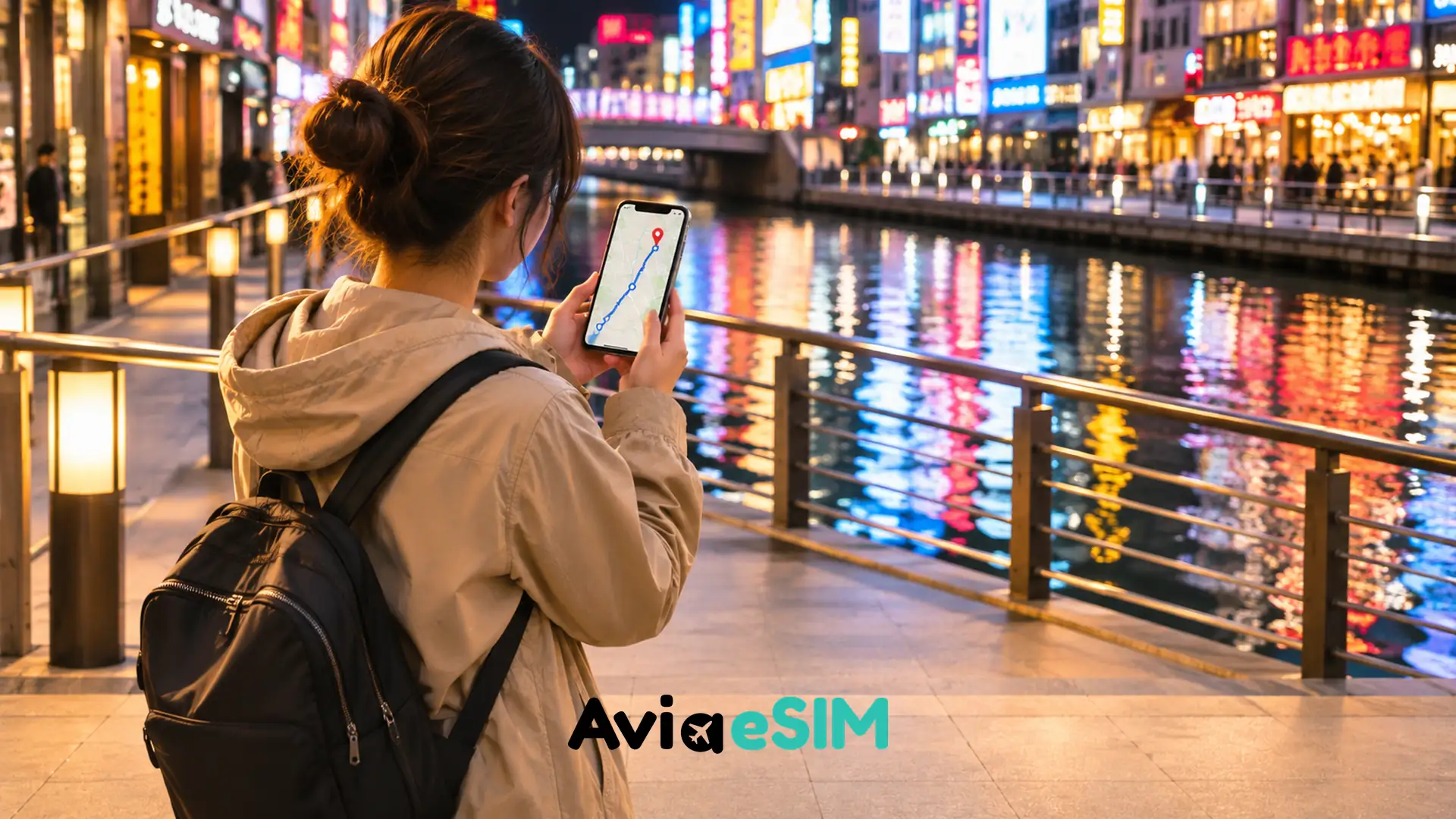
It is 9 p.m. in Dotonbori. The giant neon signs are blazing, the canal is packed with people taking photos, and you are trying to find a tiny ramen counter that a friend swore was "just around the corner." Your phone shows one bar of a café hotspot that keeps dropping, and the map spins in circles. Osaka is one of the easiest cities in Asia to explore, but only if your phone keeps up.
Here is what actually works: data at Kansai Airport, free Wi-Fi, day trips to Kyoto and Nara, and how the options compare.
How mobile internet works in Osaka for visitors
Osaka is served by the same four networks as the rest of Japan: NTT docomo, au (KDDI), SoftBank and Rakuten Mobile. Coverage in the city is excellent, including underground in the subway, inside department stores and along the shopping arcades of Shinsaibashi and Namba.
Visitors almost never sign a contract with these operators directly. You get on their networks through a prepaid tourist SIM, a rented router, a travel eSIM or roaming from your home carrier. Tourist plans are almost always data-only, so you call and message through apps such as WhatsApp or LINE rather than with a local number.
Japan's networks run on frequency bands that recent iPhone, Samsung Galaxy and Google Pixel models support well. If your phone is older or a regional variant, check its band list before you rely on any Japanese SIM or eSIM.
Buying an Osaka SIM card at Kansai Airport
Most international flights to Osaka land at Kansai International Airport (KIX), which sits on an artificial island in Osaka Bay. Terminal 1 handles most airlines, while the smaller Terminal 2 serves low-cost carriers such as Peach, Spring Airlines and Jeju Air.
Counters and vending machines in Terminal 1
The international arrivals lobby on the first floor of Terminal 1 has staffed counters for prepaid data SIMs and router rentals, and several providers also run SIM vending machines in the terminal. Kansai Airport was actually home to Japan's first SIM card vending machine back in 2014. Plans are usually sold by duration or by data volume, from a few gigabytes to unlimited data with a fair use policy.
Arriving at Terminal 2
Terminal 2 has fewer services, although vending machines and router pickup points exist on the international arrivals side. If you need a staffed counter, a free shuttle bus links Terminal 2 with Terminal 1 in around 7 to 9 minutes. With a budget flight that lands late, sorting your data before you fly saves that detour.
Check this before you buy a physical SIM
- Your phone must be unlocked. A carrier-locked handset will reject a foreign SIM card.
- Keep your home SIM safe. Store it in a labeled bag or a spare SIM case, because the tiny card is easy to lose in a hotel room.
- Check the plan validity. A 7-day plan bought on arrival day may expire before your last full day in Kansai.
Free Wi-Fi in Osaka: useful, but not something to rely on
Kansai Airport offers free Wi-Fi across both terminals, which is handy for downloading an offline map or messaging your hotel while you wait for the train. Hotels, many cafés, convenience stores and shopping malls also have free hotspots, often with a short sign-up page.
Here is a detail that older guides miss: the city-backed "Osaka Free Wi-Fi" service ended inside train stations on 31 March 2023, including Osaka Metro, Kintetsu, Keihan and Nankai stations. The Osaka Convention and Tourism Bureau said the service would continue at facilities outside stations, but you can no longer count on a free signal on the platform.
Public hotspots are also a poor fit for navigation. They cover one building at a time, they disconnect when you walk away, and open networks are not a great place to log in to banking or booking accounts. Treat free Wi-Fi as a backup and use mobile data as your main connection.
Getting from Kansai Airport into the city with data
A working connection pays off on the very first journey. Two main rail options leave from the station opposite Terminal 1:
- Nankai rapi:t to Namba: about 35 to 40 minutes, with reserved seats. The cheaper Nankai Airport Express takes about 45 minutes.
- JR Haruka limited express: about 30 minutes to Tennoji, about 50 minutes to Shin-Osaka and roughly 70 minutes to Kyoto.
With mobile data already active you can check platforms, buy rapi:t or Haruka seats online, and send your hotel an arrival time without hunting for a hotspot. For a Namba or Shinsaibashi hotel, the Nankai line usually drops you closest to your door.
Staying connected in Dotonbori, Namba and Umeda
Dotonbori is where a reliable connection matters most. The streets are crowded, side alleys look alike after dark, and many of the best small restaurants have no English sign. Mobile data lets you follow a map pin, read reviews, and translate a menu with your camera in seconds.
A few practical tips for the busiest districts:
- Screenshot reservations. Restaurant confirmations and museum tickets load instantly even if a crowded street slows your signal for a moment.
- Use exit numbers. Umeda and Namba stations are vast underground mazes. Your map app will tell you which numbered exit to take, which saves a lot of wandering.
- Carry a power bank. Navigation, photos and translation drain a battery fast on a long evening out.
If you plan to share a connection with a partner, hotspot sharing from one eSIM plan usually works fine for two phones, as long as you stay together.
Day trips to Kyoto and Nara: staying online on the train

Osaka is the perfect base for day trips, and that is where an eSIM or SIM with generous data proves its value. You check departure boards, switch platforms and look up temple opening hours while on the move, often with no time to stop at a café hotspot.
Kyoto is close and easy to reach:
- JR Special Rapid: Osaka Station to Kyoto Station in about 29 minutes.
- Shinkansen: Shin-Osaka to Kyoto in about 13 to 15 minutes, convenient if you hold a JR Pass.
- Hankyu line: Osaka-Umeda to Kyoto-Kawaramachi in about 45 minutes, handy for Gion and central Kyoto.
- Keihan line: Yodoyabashi to Sanjo in about 50 minutes, useful for Fushimi Inari, which sits on the Keihan line.
Signal is generally strong along these lines and in Nara Park. Reception can dip in deep tunnels or on wooded mountain paths, such as the upper trail at Fushimi Inari, so download offline maps of Kyoto and Nara the night before. Your Osaka data plan works the same way across the whole country, so there is nothing to change when you cross into Kyoto or continue on to the capital with a Tokyo eSIM plan.
Osaka SIM card vs eSIM vs roaming vs pocket WiFi
Each option has a place. Here is how they compare for a typical city break with a day trip or two:
- Physical tourist SIM: sold at Kansai Airport and electronics stores, data-only, needs an unlocked phone, and you have to swap out your home SIM.
- Travel eSIM: installed before you fly, active on landing, keeps your home SIM in the phone for bank text messages, and needs an eSIM-compatible, unlocked phone.
- Roaming: no setup at all, but daily roaming passes from many home carriers cost far more than a local data plan, so check your carrier's rates first.
- Pocket WiFi: one router shared by several devices, good for families who stay together, but you carry and charge an extra gadget and usually return it at the airport.
For most solo travelers and couples, an eSIM is the simplest choice. For a wider look at routers versus SIMs across the country, read our guide to Japan SIM cards, pocket WiFi and eSIMs.
How much data do you need in Osaka?
Usage depends on your habits, but a rough guide helps you avoid paying for too much or running out:
- Light use (maps, messaging, some browsing): around 1 GB every two or three days.
- Typical tourist (maps, social media, photo uploads, translation): around 1 GB per day.
- Heavy use (video calls, streaming, hotspot sharing): 2 GB or more per day, or an unlimited plan.
Prices for a week of data are usually modest; you can compare current Osaka data plans by duration and volume before you book your flights. If Osaka is one stop on a longer route, a countrywide Japan eSIM covers every city on the same plan.
How to set up an eSIM before your flight
Setup takes a few minutes and is best done at home on Wi-Fi:
- Check that your phone is unlocked and supports eSIM.
- Choose a plan and install it by scanning the QR code or using the in-app install link.
- Keep the eSIM line switched off until you land, so the validity period does not start early.
- After landing at KIX, turn on the eSIM line, enable data roaming for that line, and set it as your mobile data line.
The full process is explained step by step on our how it works page. Heading on to Seoul after Osaka? Flights between Kansai and Korea are short, and a separate South Korea eSIM can be installed in advance too.
People also ask
Can I buy a SIM card at Kansai Airport?
Yes. Terminal 1 has staffed counters in the international arrivals lobby and SIM vending machines, and Terminal 2 has vending machines on the international arrivals side. Plans for tourists are data-only.
Is there free Wi-Fi in Osaka subway stations?
Not from the city service any more. The "Osaka Free Wi-Fi" service inside Osaka Metro and private railway stations ended on 31 March 2023. Free Wi-Fi is still common in hotels, cafés, convenience stores and Kansai Airport.
Does an Osaka eSIM also work in Kyoto and Nara?
Yes. Japanese mobile networks are national, so a plan used in Osaka keeps working in Kyoto, Nara, Kobe, Tokyo and the rest of Japan.
Can tourists get a Japanese phone number with a SIM card?
Usually not. Prepaid SIMs and eSIMs for visitors are data-only, and a voice plan with a Japanese number generally requires a residence card. Calling and messaging apps work normally over mobile data.
Is pocket WiFi better than an eSIM in Osaka?
Pocket WiFi can be cheaper for a group that stays together all day. For solo travelers and couples, an eSIM is usually easier because there is no device to carry, charge or return.
One last local tip: Dotonbori is at its liveliest after dark, which is exactly when phone batteries run low. Charge your power bank before you leave the hotel and you can follow the neon all the way to that hidden ramen counter.
Osaka eSIM from $1.30: get online the moment you land at Kansai Airport and keep your data running on every day trip. Choose your Osaka eSIM plan before you fly.
Frequently asked questions
Can I buy a SIM card at Kansai Airport?
Yes. Terminal 1 has staffed counters in the international arrivals lobby and SIM vending machines, and Terminal 2 has vending machines on the international arrivals side. Plans for tourists are data-only.
Is there free Wi-Fi in Osaka subway stations?
Not from the city service any more. The Osaka Free Wi-Fi service inside Osaka Metro and private railway stations ended on 31 March 2023. Free Wi-Fi is still common in hotels, cafés, convenience stores and at Kansai Airport.
Does an Osaka eSIM also work in Kyoto and Nara?
Yes. Japanese mobile networks are national, so a plan used in Osaka keeps working in Kyoto, Nara, Kobe, Tokyo and the rest of Japan.
Can tourists get a Japanese phone number with a SIM card?
Usually not. Prepaid SIMs and eSIMs for visitors are data-only, and a voice plan with a Japanese number generally requires a residence card. Calling and messaging apps work normally over mobile data.
Is pocket WiFi better than an eSIM in Osaka?
Pocket WiFi can be cheaper for a group that stays together all day. For solo travelers and couples, an eSIM is usually easier because there is no device to carry, charge or return.
Sources
About the author
Mariami Burjanadze
Aviaesim Project Manager & Writer
I combine project management and writing at Aviaesim, where I have been part of the team since day one. My journey began at Avia.ge, where I developed my experience as a travel writer. My travels across Europe, Turkey and the United Arab Emirates continue to inspire the stories and perspectives I share with readers.
Ready to stay connected?
Browse our eSIM plans and get connected in 193 countries
Related articles
Japan SIM Card vs Pocket WiFi vs eSIM for Tourists (2026)
Japan SIM card, pocket WiFi or travel eSIM? Compare options, airport pickup, free WiFi and the best choice for solo travelers and groups in 2026.
Mariami Burjanadze
Rome Travel Internet Guide 2026: Fiumicino Airport, Wi-Fi & Mobile Data
Rome SIM card, travel eSIM or roaming? How to get online at Fiumicino, on the Leonardo Express, in the metro and around the city in 2026.
Mariami Burjanadze
Best eSIM for Turkey in 2026: A Complete Traveler Guide
The best eSIM for Turkey in 2026: networks, 5G, IMEI rules for foreign phones, how much data you need and how to get online the moment you land.
Mariami Burjanadze