South America SIM Card vs eSIM 2026: Coverage in Peru, Bolivia, Ecuador & Colombia
Compare local SIMs, travel eSIMs and roaming across Peru, Bolivia, Ecuador and Colombia, with coverage tips for Machu Picchu, Uyuni and the Andes.

Mariami Burjanadze
Aviaesim Project Manager & Writer

Key takeaways
- Peru, Bolivia, Ecuador and Colombia each run different networks, so coverage and SIM rules change at every border.
- Local SIMs usually need a passport and an official carrier store, and airport kiosks cost more than shops in town.
- Machu Picchu, the Bolivian salt flats and Colombian parks can have weak or no signal, so download tickets and maps beforehand.
- A travel eSIM installed before departure avoids store queues, and a regional plan suits routes that cross several countries.
The best eSIM for South America is usually a Latin America eSIM installed before you fly, because every country on the route has different networks and SIM rules. Local SIMs can cost less, but they need a passport and a store visit.
You land in Lima close to midnight, the arrivals hall is loud, and your phone shows a single bar. Two weeks later you will be standing in a Cusco square at 3,400 metres, trying to open a train QR code before the platform fills up. South America rewards travelers who plan route by route, yet coverage changes sharply from the coast to the Andes. This guide compares both options for Peru, Bolivia, Ecuador and Colombia, so you can decide before you board.
Best eSIM for South America: why a data plan beats a guess
Most South America itineraries cross at least one border, and many cross three. A backpacker might fly into Bogotá, travel south through Quito, then spend weeks in Peru and Bolivia. Buying a local SIM in each country sounds cheap on paper, but every purchase costs time: finding an official carrier shop, queuing with your passport, waiting for activation and sorting out a new number for banking codes.
A travel eSIM changes the math. You install the profile at home on Wi-Fi, and the data starts when you land. The best eSIM for South America depends on your route, so it helps to know what each country actually offers before choosing between a regional plan and single-country plans.
Local SIM vs travel eSIM vs roaming
Here is how the three options compare for a typical two to four week trip across the Andes:
- Local SIM: Often the lowest price per gigabyte, with a local phone number and good city speeds. The catch is the paperwork. Carriers in this region commonly ask for your passport at the point of sale, sometimes with a fingerprint or a local address, and only official stores can activate a line. Airport kiosks charge more.
- Travel eSIM: Install before you leave, no queue and no tiny SIM tray swap, so your home SIM stays in the phone for calls and bank codes. It is data only, which suits maps, rides, messaging and video calls. Check that your phone supports eSIM and is carrier unlocked.
- Roaming: The easiest option and usually the most expensive. Daily roaming passes from home carriers often cost several dollars a day for a small data allowance, which adds up quickly over a long route.
For most visitors, a travel eSIM for the first days plus an optional local SIM for a long stay in one country is the most practical mix. If you only pass through each country for a week or less, the eSIM alone is usually enough.
Peru: Lima, Cusco and the Sacred Valley
Peru has four main mobile networks: Claro, Movistar, Entel and Bitel. Travel guides generally rate Claro and Movistar as the strongest for 4G across cities and popular tourist routes. Lima, Arequipa, Cusco and Puno have dependable service. Between them, long desert and altiplano stretches can drop out, so download offline maps for bus days.
A local Peruvian SIM is available from carrier stores in Lima, Cusco and Arequipa, and the passport is required. Local eSIM profiles also exist, but activating one can still involve a store visit and identity checks, so a travel plan is simpler. A Peru eSIM starts from $2.05 at the time of writing, and city pages such as Lima and Cusco show the same entry price, so you can compare plan sizes before you travel.
Lima airport offers a short free Wi-Fi session that ends quickly, so do not plan to download maps there. Install your eSIM before the flight, and your first ride from the airport can be ordered as soon as you step out of the terminal.
Using your phone at Machu Picchu and in the Andes
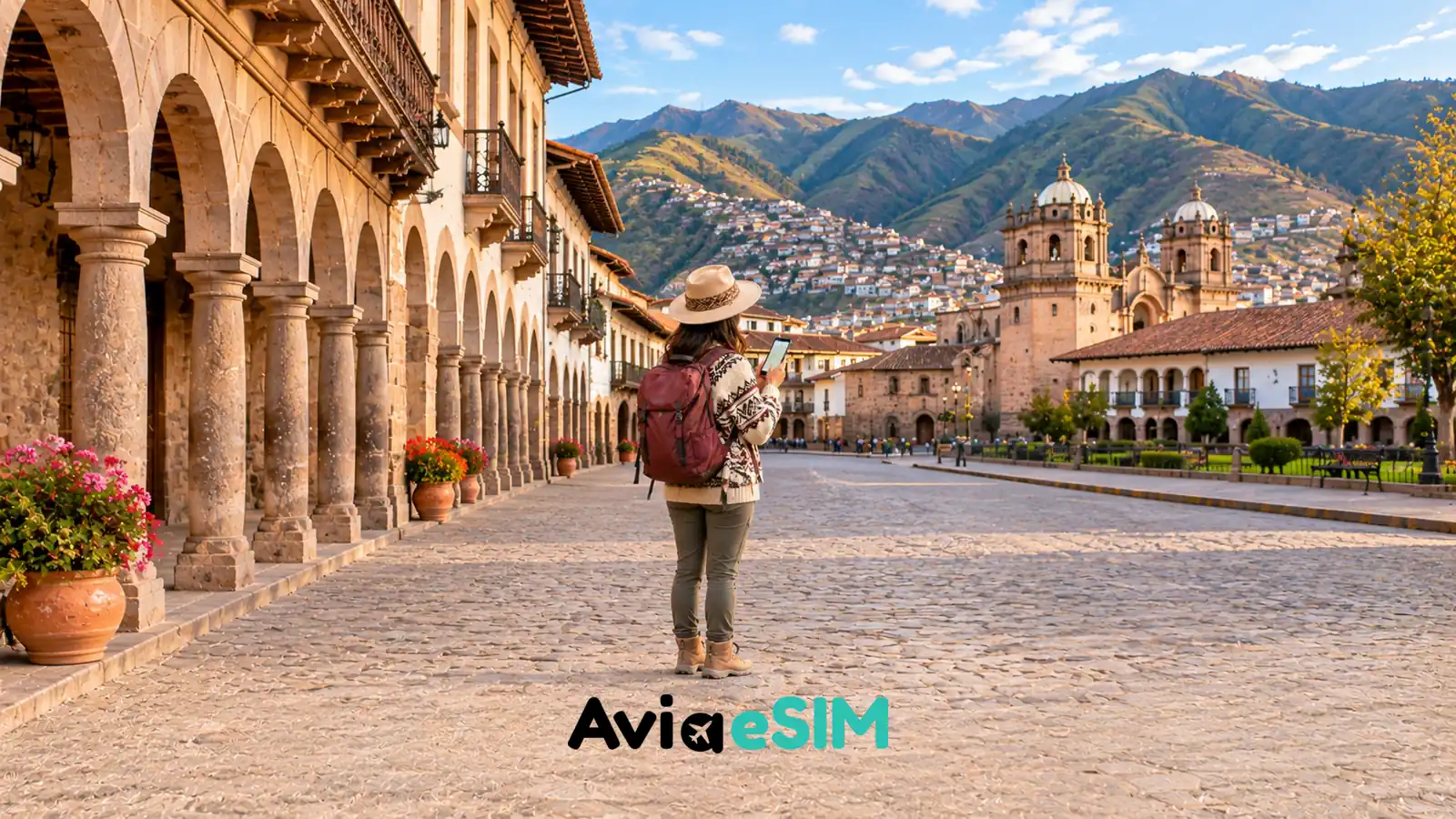
Altitude, steep valleys and old stone towns do not make for ideal signal, and it helps to set expectations. Cusco itself has solid coverage, and the town below Machu Picchu, Aguas Calientes, has service and plenty of cafes with Wi-Fi. Inside the sanctuary, reception is reported to be inconsistent, so treat it as a place to take photos, not to upload them live.
A few habits make the day smoother. Download your entry ticket and train booking as PDFs or screenshots the night before. Save the route map offline. Keep your phone in airplane mode with Wi-Fi switched on to save battery in the cold morning air. If you need to message someone in the evening, do it back in town where signal is stronger.
High-altitude days also drain batteries faster, because cold air and constant searching for signal both take a toll. A small power bank is a better investment than a bigger data plan for this part of the trip.
Bolivia: La Paz, Uyuni and the dead zones
Bolivia has three operators: Entel, Tigo and Viva. Guides written for visitors generally describe Entel as the most reliable on the altiplano and in rural areas, with Tigo performing well in the big cities. Coverage thins out dramatically on the salt flat tours, around Lake Titicaca crossings and in the Amazon lowlands around Rurrenabaque, where several networks have little or no service.
That matters for planning. If your Uyuni tour has a driver and a fixed itinerary, the missing signal is rarely a problem, but you should arrange meeting points, flights and accommodation before you leave the city. A local SIM needs a passport and an official carrier shop, and airport kiosks in El Alto can have unpredictable hours. A Bolivia eSIM from $2.59 skips that queue, which is helpful when you arrive tired at high altitude and want to order a taxi.
Ecuador: Quito, the Andes and the coast
Ecuador is served mainly by Movistar and Claro, with the state operator CNT playing a smaller role. Reviewers who travel the country often suggest Movistar for a physical SIM and Claro for remote areas, though both give decent service in Quito, Cuenca and Guayaquil. Mountain roads between cities can mean slower 3G stretches, but the main tourist corridors are usually fine.
Because the US dollar is the national currency, prices are easy to compare, and tourist packages at the airport tend to cost more than the same data bought in town. A Ecuador eSIM from $2.38 is a good match if you are using Quito as a base, and the Quito page lists the plans at the same price. If your trip includes the Galapagos Islands, check coverage with your provider before you go, because island networks differ from the mainland.
Colombia: Bogotá, Medellín and the Caribbean coast
Colombia has Claro, Movistar, Tigo and WOM, and Claro is usually described as the strongest outside the big cities. Bogotá, Medellín, Cartagena and the Coffee Region have dependable 4G, while national parks and mountain areas such as the Sierra Nevada can be patchy. Some foreign phones may need to be registered on the national IMEI list for a local SIM, which store staff can usually do at activation.
Registration is also required for the line itself, so bring your passport and your accommodation address. Street vendors selling pre-activated SIM cards are best avoided. A Colombia eSIM starts from $4.21, and the Bogotá page gives you the same entry price if you are landing there first.
Colombia also has a well-known phone theft problem in busy city areas, so a simple rule helps: take your phone out only when you need it, keep it away from the curb, and use a cheap case with a strap.
How to choose the right setup for your route
Start with how many countries you will cross and how long you will stay in each. Then match the plan to the trip:
- One country, two weeks or less: a single-country eSIM is simple and the best value.
- Three or four countries on one route: a regional plan avoids installing and switching between several profiles.
- A month or more in one country: consider a local SIM after your first week, once you know your usage and have time for the store visit.
Before departure, confirm your phone is unlocked, update its software, install the eSIM while you still have home Wi-Fi, and keep the original SIM active for calls. On arrival, switch on data roaming for the eSIM line only and turn it off for your home SIM, so you are not billed for roaming by accident.
One last tip: take a screenshot of your eSIM activation details and keep it offline. If you ever need to reinstall the profile in a hostel with weak Wi-Fi, you will be glad it is already on your phone.
Latin America eSIM from $4.68: one install for your whole South America route, ready before you land.
Frequently asked questions
Which is the best eSIM for South America?
It depends on your route. For one or two countries, a single-country eSIM for Peru, Ecuador, Bolivia or Colombia is usually the best value, while a regional Latin America eSIM suits trips that cross several borders.
Do I need a passport to buy a local SIM card in South America?
Usually yes. Carriers in Peru, Bolivia and Colombia commonly ask for your passport at the point of sale, and only official carrier stores can activate a line. A travel eSIM installed before departure avoids this step.
Does mobile data work at Machu Picchu?
Cusco and the town of Aguas Calientes have service, but reception inside the sanctuary is reported to be inconsistent. Download your tickets, train booking and maps beforehand.
Which mobile networks operate in Peru, Bolivia, Ecuador and Colombia?
Peru has Claro, Movistar, Entel and Bitel. Bolivia has Entel, Tigo and Viva. Ecuador has Movistar, Claro and CNT. Colombia has Claro, Movistar, Tigo and WOM.
Is roaming cheaper than a travel eSIM in South America?
Usually not for trips longer than a few days. Daily roaming passes from home carriers often cost several dollars a day for a small data allowance, while a travel eSIM is priced per plan.
What do I need to check before installing a travel eSIM?
Confirm that your phone supports eSIM and is carrier unlocked, update its software, and install the profile on Wi-Fi before departure. Keep your home SIM active for calls and bank codes.
About the author
Mariami Burjanadze
Aviaesim Project Manager & Writer
I combine project management and writing at Aviaesim, where I have been part of the team since day one. My journey began at Avia.ge, where I developed my experience as a travel writer. My travels across Europe, Turkey and the United Arab Emirates continue to inspire the stories and perspectives I share with readers.
Heading to South America?
Install a Latin America eSIM before you fly and land online. Plans from $4.68.
Related articles

Cancun & Tulum Travel Internet Guide: Airport, Hotel Zone & Cenote Coverage
Plan your Cancun SIM card or eSIM: airport arrival, Hotel Zone coverage, Tulum Wi-Fi and what to expect inside cenotes and on jungle roads.
Mariami Burjanadze
Mexico SIM Card for Tourists 2026: Telcel, AT&T Mexico or eSIM?
Compare a Mexico SIM card from Telcel, AT&T Mexico or Movistar with a travel eSIM, plus 2026 registration rules and coverage tips for tourists.
Mariami Burjanadze
Mexico City Travel Internet Guide: Airport, Metro, Uber & Mobile Data
Mexico City SIM card guide: airport SIMs, Metro signal, Uber and DiDi, free Wi-Fi limits, and how a travel eSIM compares with roaming.
Mariami Burjanadze