Spain SIM Card for Tourists 2026: Movistar, Orange, Vodafone or eSIM?
Compare a Spain SIM card from Movistar, Orange or Vodafone with a travel eSIM, and learn how passport registration works for tourists.

Mariami Burjanadze
Aviaesim Project Manager & Writer

Key takeaways
- Tourists can buy a prepaid Spain SIM card from Movistar, Orange, Vodafone and cheaper brands, but the SIM must be registered with a passport or national ID.
- Prepaid monthly plans for visitors typically cost around 10 to 20 euros, but allowances change often, so check the operator's current offer.
- Airport kiosks are convenient but often cost more than city shops, so compare before you buy.
- A travel eSIM can be installed before you fly, needs an unlocked eSIM-capable phone and is usually data only.
- Coverage is strong in Madrid and Barcelona but can be patchy in mountains, villages and on some islands, so save offline maps.
The easiest Spain SIM card for tourists is a prepaid SIM from Movistar, Orange or Vodafone registered with your passport, or a Spain eSIM installed before you fly. The eSIM skips the shop; the SIM gives you a local number.
You land in Madrid, the plane doors open, and your phone finds nothing but a roaming warning. The kiosk in the arrivals hall wants your passport, a queue has already formed, and the price on the board is not the one you saw online. A Spain SIM card sounds simple until you try to buy one at the wrong moment. This guide compares the options, explains the passport rule and shows which one suits your trip.
Do tourists really need a Spain SIM card?
For most visitors, yes. Hotel and cafe Wi-Fi is fine for emails, but it will not guide you through Madrid at night, translate a menu in Seville or let you book a taxi when the train station is crowded. Mobile data also keeps your maps, ticket apps and messaging working between stops.
Roaming from a home network outside the European Union can be expensive, and the protections that make roaming cheap inside the EU apply to customers of EU operators, not automatically to every visitor. Before you pay for a roaming day pass, compare it with a local SIM or an eSIM, because both usually cost far less for a week of normal use.
Spain SIM card, travel eSIM or roaming: how they compare
Each option solves a different problem. Here is the short version before the details:
- Local prepaid SIM: a physical card from an operator such as Movistar, Orange or Vodafone, usually with a Spanish phone number, large data allowances and a mandatory passport check at the counter.
- Travel eSIM: a digital plan you install by QR code, normally data only, active the moment you land, with no shop visit and no passport check at a counter.
- Home roaming: no setup at all, but often the most expensive route unless your provider includes Spain in a travel bundle.
- Public Wi-Fi only: free, but patchy, slower on crowded networks and a poor fit for navigation and bank logins.
If you mainly need maps, messaging and ride apps, a travel eSIM is the simplest choice. If you want a Spanish number for restaurant bookings or a long stay, a local SIM makes more sense.
Movistar, Orange, Vodafone and the low-cost brands
Spain has four large mobile groups and a crowd of cheaper brands that run on their networks. Prices and data allowances change often, so treat the figures below as rough guides and check the operator's current offer before you queue. Prepaid plans for visitors typically run around 28 to 30 days, and many cost somewhere around 10 to 20 euros for a month of data.
Movistar
Movistar is the incumbent and is often praised for rural and inland coverage. It can also cost more than its rivals, and like every operator it will ask for your passport. A good pick if you are driving through small towns and want the widest footprint.
Orange
Orange is now part of the MasOrange group alongside Yoigo, and it is a popular choice for straightforward prepaid plans with generous data. Shops are easy to find in cities, and activation is usually quick once the passport check is done.
Vodafone
Vodafone has strong city coverage and plenty of stores in Madrid and Barcelona. Prepaid lines can come with rules on top-ups and keeping the line active, so read the terms if you plan to stay longer than a few weeks.
Digi, Lowi, Simyo and other cheaper brands
Budget brands can offer large data allowances for less money, which is tempting. The trade-offs are usually fewer physical shops and customer support that may work mainly in Spanish. For a one-week holiday, the saving rarely justifies the extra effort.
The passport rule: how SIM registration works in Spain
Spain requires every prepaid SIM to be registered to a real identity. In practice that means showing your passport or national ID at the shop, and the staff member enters your details before activating the line. Do not plan to buy a SIM from a street seller or an unmanned stand: without registration the card will not work, and you could be left without data on your first night.
Bring the original passport rather than a photo, keep your phone unlocked, and expect the process to take anywhere from a few minutes to much longer during queues. A SIM card that is registered in your name should also be kept in a safe place, because it is linked to you.
Buying a SIM in a Spanish shop: what to bring and what to expect
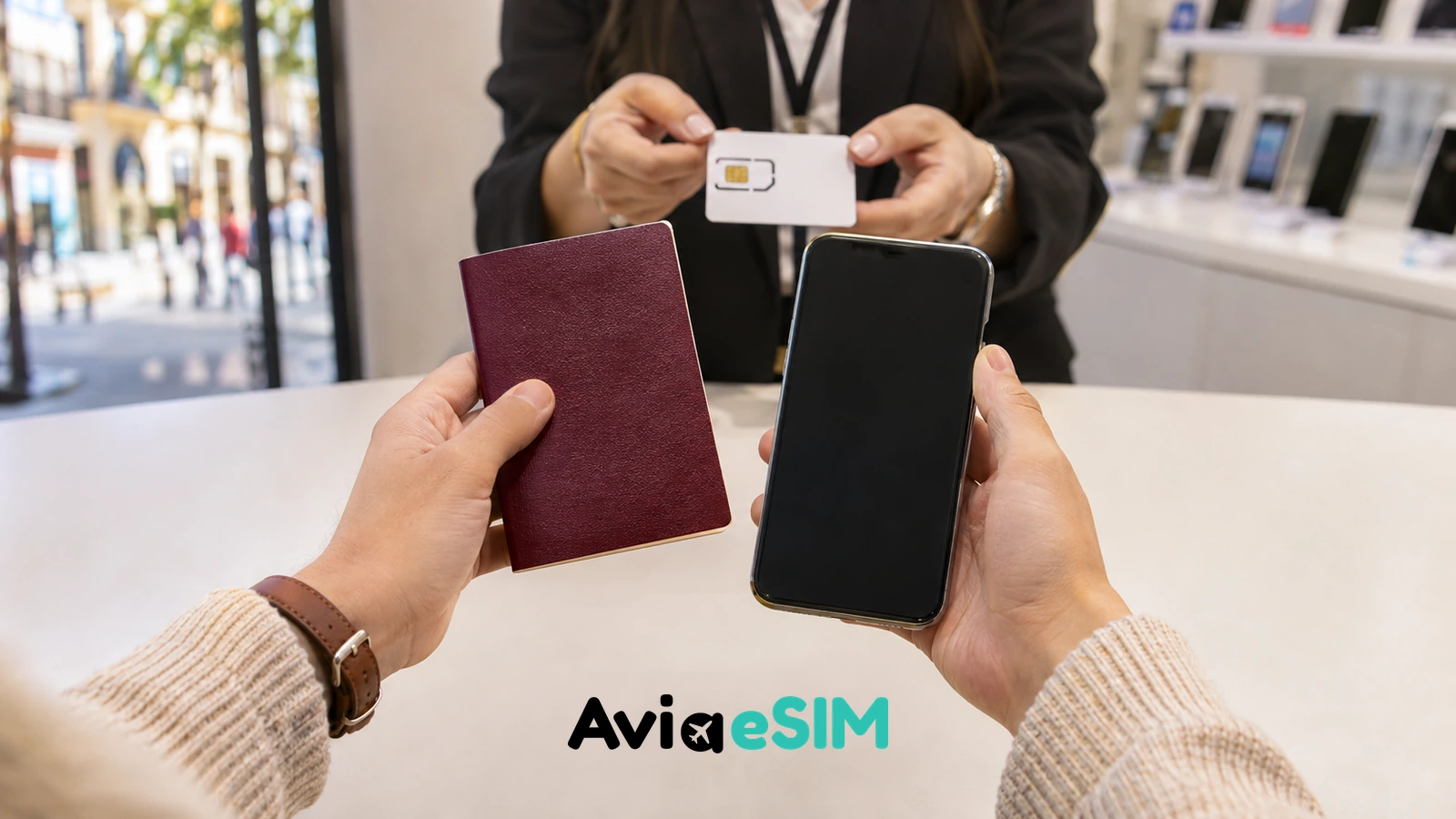
Official stores of Movistar, Orange, Vodafone and Yoigo are easy to find in city centers and shopping malls. Walk in with your passport, an unlocked phone and a rough idea of the data you need, then ask for the prepaid tourist plan. Staff usually insert the SIM, activate it and confirm that it works before you leave the counter.
Airport kiosks are convenient but often charge more than city shops for the same plan. If you can wait, take the metro into town and buy there, or land with an eSIM already installed and skip the counter entirely. In Barcelona, our Barcelona SIM card guide explains how the El Prat airport shops, Wi-Fi and metro connectivity fit together.
How a travel eSIM for Spain works
An eSIM is a SIM built into your phone. You buy a plan online, scan a QR code or tap an install link while still on home Wi-Fi, and switch the plan on when you arrive. Most travel plans are data only, which is exactly what maps, WhatsApp, ride apps and streaming need. Your home SIM stays in the phone, so you keep your usual number for bank texts and two-factor codes.
Check three things before you buy. First, your phone must support eSIM and be network unlocked. Second, make sure the plan covers Spain and lists the data amount and number of days clearly. Third, confirm whether it offers hotspot sharing if you plan to use a laptop. The current Spain eSIM page lists plans from $1.40, depending on data and validity.
Coverage in Madrid, Barcelona and beyond
Large Spanish cities have good 4G and 5G coverage on all major networks, so a Madrid eSIM or a Barcelona eSIM works well for city breaks. Underground metro tunnels, old town alleys and beaches can still have weak spots, so download offline maps for your route as a backup.
Outside the cities, coverage becomes more uneven. Mountain roads, national parks and small villages may drop to a weak signal, and the Balearic and Canary Islands depend on the operator and the exact spot. If you are driving a long route, save the area in offline maps and tell your companions where the nearest town is.
How much data do you need in Spain?
Maps, messaging, ride apps and a few photos use surprisingly little data, and a week of ordinary sightseeing often fits in a few gigabytes. Video calls, streaming, social video and hotspot sharing use much more. Choose a plan one step larger than your estimate, because running out in the middle of a day trip is the most common complaint travelers report.
If you are combining Spain with a wider European route, look at plans that cover several countries. A regional Europe eSIM can replace three or four separate SIM cards, while single-country plans such as Portugal or France may be cheaper if you only cross one border.
Which option fits which traveler
- Short city break: a travel eSIM saves time at the airport and avoids the passport queue.
- Two weeks on the road: a prepaid SIM from Movistar or Orange gives you a large allowance and a Spanish number.
- Long stay or remote work: a local SIM or a Spanish contract brand with a reliable top-up plan.
- Multi-country trip: a regional eSIM. If your route also covers Italy, see our Italy SIM card guide.
People also ask about SIM cards in Spain
Can tourists buy a SIM card in Spain?
Yes. Tourists can buy a prepaid SIM in operator stores and some authorized shops, but they must show a passport or national ID so the SIM can be registered in their name.
Which is the best SIM card in Spain for tourists?
There is no single best choice. Movistar is often cited for coverage in remote areas, Orange for simple prepaid plans and Vodafone for city coverage, while an eSIM is the easiest option for short trips.
Is an eSIM better than a physical SIM in Spain?
For short stays, usually yes, because you can install it before you fly and skip the shop. A physical SIM is better when you need a Spanish phone number or a very large data allowance.
Can I use my home phone plan in Spain?
Sometimes. If your provider is outside the EU, roaming can be costly unless it offers a travel bundle, so compare the daily price with a local SIM or an eSIM before you leave.
Do I need to unlock my phone for a Spanish SIM or eSIM?
Yes. A phone locked to its home carrier will usually reject a Spanish SIM or eSIM, so contact your provider before the trip if you are unsure.
One last practical tip: after you activate any new SIM or eSIM, turn off data roaming for your home line and set the new line as your mobile data source, so you do not pay by accident for the wrong plan.
Frequently asked questions
Can tourists buy a SIM card in Spain?
Yes. Tourists can buy a prepaid SIM in operator stores and some authorized shops, but they must show a passport or national ID so the SIM can be registered in their name.
Which is the best SIM card in Spain for tourists?
There is no single best choice. Movistar is often cited for coverage in remote areas, Orange for simple prepaid plans and Vodafone for city coverage, while an eSIM is the easiest option for short trips.
Is an eSIM better than a physical SIM in Spain?
For short stays, usually yes, because you can install it before you fly and skip the shop. A physical SIM is better when you need a Spanish phone number or a very large data allowance.
Can I use my home phone plan in Spain?
Sometimes. If your provider is outside the EU, roaming can be costly unless it offers a travel bundle, so compare the daily price with a local SIM or an eSIM before you leave.
Do I need to unlock my phone for a Spanish SIM or eSIM?
Yes. A phone locked to its home carrier will usually reject a Spanish SIM or eSIM, so contact your provider before the trip if you are unsure.
Sources
About the author
Mariami Burjanadze
Aviaesim Project Manager & Writer
I combine project management and writing at Aviaesim, where I have been part of the team since day one. My journey began at Avia.ge, where I developed my experience as a travel writer. My travels across Europe, Turkey and the United Arab Emirates continue to inspire the stories and perspectives I share with readers.
Ready to stay connected?
Browse our eSIM plans and get connected in 193 countries
Related articles

Barcelona Travel Internet Guide 2026: El Prat Airport, Metro & Beach Wi-Fi
How to get online in Barcelona: El Prat airport Wi-Fi, local SIM cards vs travel eSIMs, metro tips and staying connected on the beach.
Mariami Burjanadze
Osaka Travel Internet Guide: Kansai Airport, Dotonbori & Day Trips to Kyoto
How to get online in Osaka: SIM cards at Kansai Airport, the end of free station Wi-Fi, Dotonbori tips and data for day trips to Kyoto and Nara.
Mariami Burjanadze
Japan SIM Card vs Pocket WiFi vs eSIM for Tourists (2026)
Japan SIM card, pocket WiFi or travel eSIM? Compare options, airport pickup, free WiFi and the best choice for solo travelers and groups in 2026.
Mariami Burjanadze